Sedona Red Rock Pass, Trailhead Parking and Fees Explained (2026)
Sedona has no entrance gate and no ticket, which is why visitors are often surprised by a parking citation. Most of the land around town is the Coconino National Forest, and if you leave your car at one of its fee sites, a trailhead, a vista or a picnic area, you need a Red Rock Pass or an America the Beautiful pass. On the forest’s pass page, last updated June 17, 2026, a Red Rock Pass costs $5 a day, $15 a week or $20 a year and covers everyone in the vehicle.
Two other sets of fees sit alongside it. Five creekside sites run by a concessionaire, including Crescent Moon at Red Rock Crossing and Call of the Canyon at the West Fork trail, charge their own daily fees of $12 to $15 and accept neither pass. And Slide Rock and Red Rock state parks charge state park entrance fees. This guide explains which fee applies where, how to buy each pass, how the free trailhead shuttle can save you the trouble, and the days in 2026 when the forest waives its fees.
The short version
| Where you park | What you need | Cost |
|---|---|---|
| Forest trailheads, vistas and picnic sites (Cathedral Rock, Bell Rock, Boynton Canyon, the Devil’s Bridge area and more) | Red Rock Pass or America the Beautiful pass | $5 a day, $15 a week, $20 a year |
| Call of the Canyon / West Fork, Crescent Moon, Grasshopper Point | Site fee or Coconino Hospitality Annual Pass | $15 a day each |
| Beaver Creek Day Use Picnic Site | Site fee or Coconino Hospitality Annual Pass | $14 a day |
| Lower Lake Mary Picnic Area | Site fee or Coconino Hospitality Annual Pass | $12 a day |
| Slide Rock State Park | State park entrance fee | $20.00 per vehicle for 1-4 people from August 22, 2026 |
| Red Rock State Park | State park entrance fee | $10.00 per adult (14+) |
| A quick photo stop, about 15 minutes or less | Nothing | Free |
What the Red Rock Pass is, and when you need it
The Red Rock Pass is a recreation pass sold by the Coconino National Forest for its Sedona-area day-use sites. The forest’s rule is simple: if you leave your vehicle while recreating at a fee site on the forest, you must buy a recreation pass. The pass lets you park at any Sedona-area fee site the forest manages, for as long as it is valid.
There are three versions, and each covers everyone in the vehicle. The cardholder must be present:
- Daily: $5.
- Weekly: $15.
- Annual: $20.
What it does not require:
- A short stop. According to the Sedona Chamber’s explanation of the program, a pass is not required for incidental stopping to take a photograph or enjoy a scenic vista, approximately 15 minutes or less.
- Driving through. The fee applies to parking at a fee site, not to driving the highways and forest roads.
What happens if you skip it: vehicles parked on the forest in the red rock area without a valid pass on display, or bought online, may get a citation.
Which sites need the pass
The forest lists the fee sites by name. In and around Sedona, those that take a Red Rock Pass or an America the Beautiful pass include:
- Cathedral Rock Trailhead, off SR-179 on Back O’ Beyond Road.
- Bell Rock Pathway/Vista and Courthouse Vista, on SR-179 near the Village of Oak Creek.
- Little Horse Trailhead, also on SR-179.
- Boynton Canyon Trailhead and Fay Canyon Trailhead, in the western canyons.
- Dry Creek Trailhead and Mescal Trailhead, the approaches to Devil’s Bridge and the Dry Creek area.
- Bear/Doe Mountain Trailhead, Jim Thompson Trailhead and Huckaby Trailhead.
- Midgley Bridge, Encinoso, Halfway and Bootlegger picnic areas, and Yavapai Vista, along SR-89A and SR-179.
- Palatki Heritage Site, Honanki Heritage Site and Crane Petroglyph Heritage Site, the cliff dwellings and rock art sites northwest of town.
- Baldwin, Bell and Bruce Brockett trailheads.
Farther afield, the same passes work at Lava River Cave and the Lake Mary sites near Flagstaff.
The Sedona Chamber explains that the fee sites are among the most heavily visited places on the whole forest, which is why they charge. Under the federal law that governs these fees, 95% of recreation fee revenue stays with the national forest where it is paid. The Chamber puts the share that goes back into the Red Rock sites at 90 cents of every dollar: restrooms, picnic areas, trail work, signs, fire patrols, trash and graffiti removal, and new trailheads.
Where the Red Rock Pass does not work
This is the part that catches people out.
The five concessionaire sites. Five sites on the forest are run by a concessionaire and charge a fee known as the Coconino Hospitality Annual Pass. They do not recognize the Red Rock Pass or the America the Beautiful pass. Each has its own daily fee:
- Call of the Canyon Picnic Site / West Fork: $15 per vehicle for up to 5 people, or $4 a person if you walk in, cycle or arrive by bus. This is the trailhead for the West Fork of Oak Creek, one of the most popular hikes on the forest, 9.5 miles north of Sedona. Its paved lot fills quickly, especially at the peak of fall color, vehicles longer than 24 ft are turned away, and there is no drinking water. A forest order closed the West Fork trail from September 26 through October 31, 2026, to protect visitors from rockfall and flood debris after the Pocket Fire, so check before you go.
- Crescent Moon Picnic Site: $15 a day. This is Red Rock Crossing, where Cathedral Rock is reflected in Oak Creek, one of the most photographed scenes in the Southwest. Recreation.gov’s listing suggests coming early in the morning or on a weekday to avoid the crowds.
- Grasshopper Point Swimming & Picnic Area: $15 a day.
- Beaver Creek Day Use Picnic Site: $14 a day.
- Lower Lake Mary Picnic Area: $12 a day.
If you visit these often, the Coconino Hospitality Annual Pass costs $25 for a week or $50 for a year and covers up to 5 people per vehicle, but only at those five sites. It cannot be bought online; you buy it at the sites themselves. It replaced the old Grand Annual Pass, which has been discontinued.
State parks. The Red Rock Pass is valid only on Coconino National Forest sites. It does not work at national parks or Arizona state parks. Around Sedona that means:
- Slide Rock State Park in Oak Creek Canyon charges by the vehicle: $20.00 for 1-4 people from August 22, 2026 to April 2027, plus $5.00 for each extra person, and $30.00 per vehicle from May to August 21 in 2026. Children under 6 are free. There are no reservations, no walk-ins, drop-offs or bicycle entries, and you may not line up on the highway before opening or when the lot is full. Card payment is preferred; cash users need exact change.
- Red Rock State Park, southwest of town, charges by the person: $10.00 for adults (14+), $5.00 for youth (7-13), free for children 6 and under, and $5.00 for walk-ins. It is open 8:00 a.m. to 5:00 p.m., with last entry at 4:30 p.m. There is no swimming and pets are not allowed.
Campgrounds and developed swimming areas. Recreation passes cover standard day-use fees only. They do not cover campgrounds, highly developed swimming areas or concessionaire-managed sites.
The America the Beautiful pass
If you are visiting other national parks or forests on the same trip, the America the Beautiful pass may be the better buy. It covers 2,000 recreation areas run by federal land agencies, and the Coconino National Forest accepts it in place of a Red Rock Pass at many Sedona-area sites. On the forest’s pass page:
- Annual: $80.
- Senior Annual: $20. Senior Lifetime: $80.
- Military Annual, Military Lifetime and Military Access: free.
- Fourth graders: free.
Like the Red Rock Pass, it covers everyone in the vehicle and the cardholder must be present. It does not cover the five concessionaire sites. If you need the pass within 10 days or less, the forest recommends paying for expedited shipping on an online order or buying it in person.
How to buy a Red Rock Pass
- Online at Recreation.gov. No printed pass is issued; your license plate number is recorded instead. If you change plates while the pass is valid, contact the Recreation.gov help center.
- At the trailhead. Kiosk fee machines at the sites that need a pass sell the daily, weekly and annual versions.
- In town. The Sedona Chamber of Commerce sells the passes, and so does the Red Rock Ranger District Visitor Center, at 8375 State Route 179 near the Village of Oak Creek (928-203-2900), open 9 a.m. to 4:30 p.m., and 12 p.m. to 4:30 p.m. on Wednesdays.
A physical pass must be displayed in the windshield. An online pass is checked against your plate.
A note on the visitor center: the forest’s pass page says it sells the daily and weekly passes but not the annual one, while its Recreation.gov listing says it sells annual passes only. If you want a specific version, buy it online or at a kiosk.
Which pass should you buy?
- One day of hiking: a daily pass, $5. One pass covers every fee site you park at that day.
- Three days or more: the weekly pass, $15, is cheaper than three daily passes.
- More than one week a year, or a local: the annual pass, $20.
- Visiting national parks on the same trip: the America the Beautiful pass, $80, covers them and replaces the Red Rock Pass at most Sedona sites.
- Seniors and military: check the America the Beautiful options first; the senior annual pass is $20 and military passes are free.
- Planning to swim or picnic at Crescent Moon, Grasshopper Point or West Fork: budget the $15 site fee on top, or the Coconino Hospitality pass if you will return.
The free trailhead shuttle
Several of the busiest trailheads have small lots, and the free Sedona Shuttle lets hikers leave their cars in town instead. The Sedona Shuttle Trailhead Routes run from three park-and-ride lots to the Cathedral Rock, Soldier Pass and Dry Creek Road trailheads, Thursdays to Sundays between 7:00 AM and 5:30 PM, and the service is free. The Forest Service’s own Cathedral Rock page suggests it.
For getting around town, the on-demand Sedona Shuttle Connect costs $2 a ride, Thursdays to Sundays from 6:30 AM to 8:30 PM. Timetables change with the season, so check the city’s shuttle site before relying on it.
Trail by trail: the big names
Cathedral Rock
The most photographed rock in Sedona has one of the shortest and steepest trails. The Forest Service rates Cathedral Rock Trail No. 170 as strenuous and calls it more of a rock climb than a hike: unshaded, steep and difficult in places, with a few toeholds cut into the rock. Its trail page gives 1.1 miles round trip, 669 ft of elevation gain from a trailhead at 4,043 ft, and about 1.5 hours. It is hot in summer.
The trailhead is 3.5 miles south of the SR-89A and SR-179 junction on SR-179, then 0.6 miles along Back O’ Beyond Road. Parking needs a Red Rock Pass or an America the Beautiful pass, and the lot is small, which is why the Forest Service points hikers to the free shuttle from Thursday to Sunday.
Bell Rock and Courthouse Butte
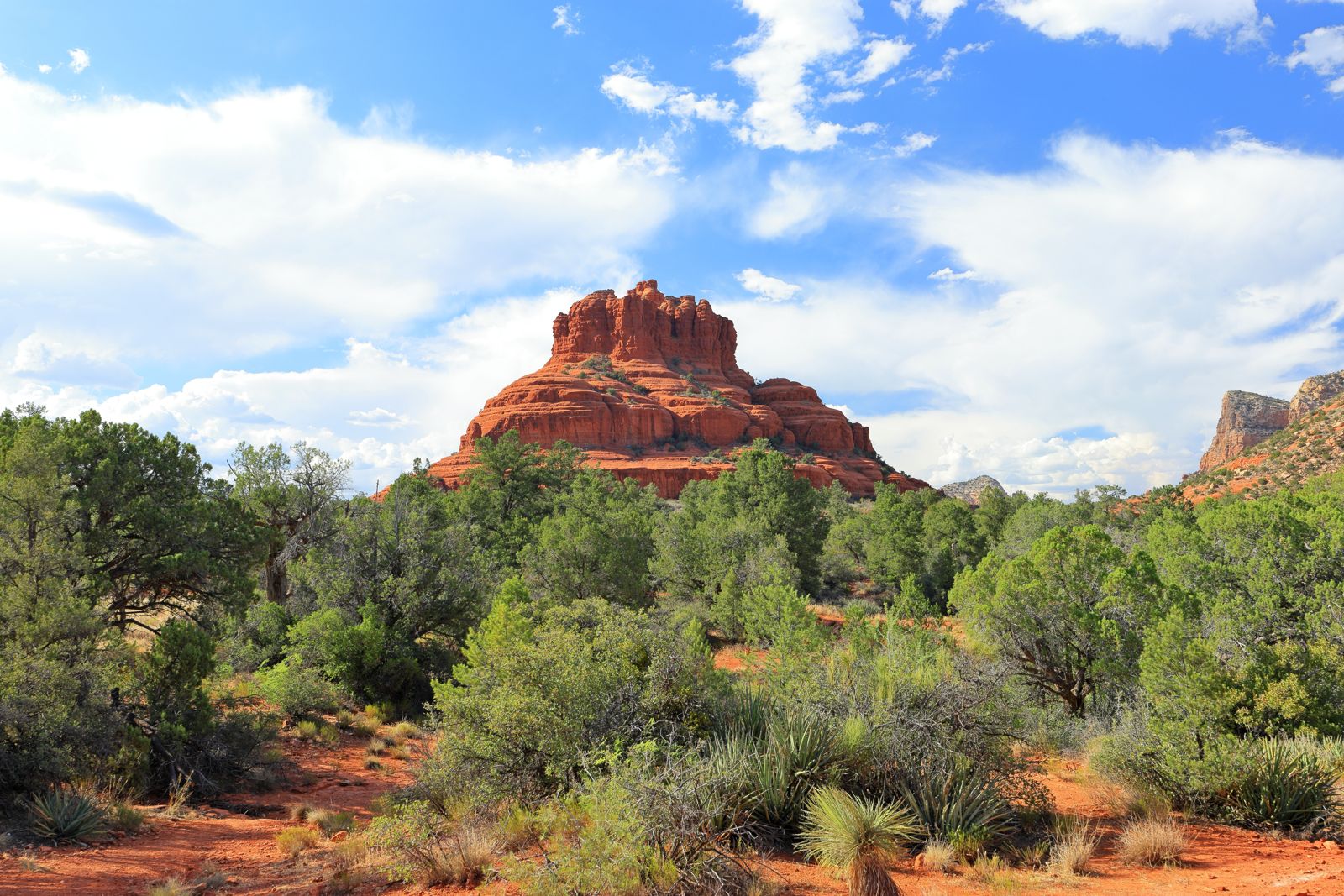
The Bell Rock Pathway is a 3.6-mile trail with views of Bell Rock and Courthouse Butte, mostly wide and hard-surfaced, with some steep hills. Both rocks lie in the 18,150-acre Munds Mountain Wilderness. The Bell Rock Pathway/Vista and Courthouse Vista lots both need a pass.
Devil’s Bridge and the Dry Creek area
Devil’s Bridge is the largest natural sandstone arch in the Sedona area, 50 feet high, and you can walk across the top. The Forest Service rates Devil’s Bridge Trail No. 120 as moderate: 1.6 miles round trip and 371 ft of climbing, about 2 hours. The catch is the road to its own small trailhead. From SR-89A it is two miles up paved Dry Creek Road, then about 1.3 miles up the unpaved part (FR 152), which is rough, needs a high-clearance vehicle and is not recommended in wet weather. It is also a popular jeep trail and not recommended for walking.
With an ordinary car, the Forest Service recommends two longer approaches:
- From Dry Creek Vista, at the end of the pavement, by the Chuckwagon Trail: about 2.9 miles to the bridge, 5.8 miles round trip, on moderately easy rolling trail.
- From the Mescal Trailhead, 0.2 miles along Long Canyon Road: 4.0 miles round trip using the signed Mescal and Chuckwagon connection.
The Dry Creek and Mescal trailheads are both on the fee list, so you need a Red Rock Pass or an America the Beautiful pass to park there. From Thursday to Sunday, the free shuttle to the Dry Creek Road trailhead avoids the parking question altogether. This is also where many jeep tours run, which is one reason visitors without a high-clearance vehicle book one.
Soldier Pass
Soldier Pass Trail No. 66 leads to the Devil’s Kitchen sinkhole and the Seven Sacred Pools: 4 miles round trip, 641 ft of gain, about 2.5 hours, rated moderate. Parking is the problem. The trailhead has only 14 parking spots and no trash or restroom facilities, and the Forest Service itself suggests the free Sedona Shuttle instead. Driving on beyond the trailhead on the unpaved road needs a separate motorized access permit, which is why jeep tours that go up Soldier Pass are a different thing from parking at the trailhead.
Boynton Canyon and the western canyons
Boynton Canyon, one of the four best-known vortex sites, and nearby Fay Canyon each have a fee trailhead.
Palatki and Honanki
The Palatki and Honanki heritage sites, with cliff dwellings and rock art, are both on the pass list. Check access and booking details with the Red Rock Ranger District before you drive out.
Fee-free days in 2026
The Forest Service waives day-use fees at many sites on certain days. The Coconino National Forest’s list for 2026:
- January 17-19, Martin Luther King, Jr. weekend.
- February 14-16, Presidents Day weekend.
- May 23-25, Memorial Day weekend.
- June 6, National Trails Day; June 13, National Get Outdoors Day; June 19, Juneteenth.
- July 4, Independence Day; August 4, Great American Outdoors Day.
- September 5-7, Labor Day weekend; September 17, Constitution Day; September 26, National Public Lands Day.
- October 12, Columbus Day; October 27, Theodore Roosevelt’s birthday.
- November 11, Veterans Day; November 26, Thanksgiving Day.
- December 25, Christmas Day, and January 1, 2027.
Fee-free days apply to the forest’s own day-use fees. Expect the trailheads to be busier, not emptier.
Do tours need a pass?
The pass is for leaving your own vehicle at a fee site. If a jeep, van or vortex tour drives you around, you are not parking at the trailheads yourself, which is one reason tours appeal to visitors staying only a day. If you drive to an operator’s office in town and join the tour there, the question does not arise. The tours compared guide covers what each tour includes, and the tours page lists them with live prices.
Practical checklist
- Buy before you go. A daily pass online or at the first kiosk covers the whole day.
- Display it. A physical pass goes in the windshield; an online pass is tied to your plate.
- Budget separately for Crescent Moon, Grasshopper Point, West Fork and the state parks.
- Use the shuttle to Cathedral Rock, Soldier Pass and Dry Creek Road from Thursday to Sunday.
- Arrive early at Slide Rock and the creekside sites in warm weather; there are no reservations.
- Getting there: our guide to getting to Sedona covers the drive and the shuttles.
Frequently asked questions
How much is a Red Rock Pass in 2026?
$5 for a day, $15 for a week or $20 for a year, on the Coconino National Forest’s pass page. It covers everyone in the vehicle.
Do I need a Red Rock Pass to drive around Sedona?
No. You need one to park and leave your vehicle at a forest fee site such as a trailhead or vista. A stop of about 15 minutes or less for a photo needs no pass.
Does the America the Beautiful pass work in Sedona?
Yes, at the Red Rock Pass sites. It does not cover the five concessionaire sites, such as Crescent Moon and Call of the Canyon, or the state parks.
Do I need a pass for Cathedral Rock?
Yes, to park at the trailhead. From Thursday to Sunday the free Sedona Shuttle runs from park-and-ride lots to the Cathedral Rock trailhead.
Does the Red Rock Pass cover Slide Rock State Park?
No. Slide Rock charges its own entrance fee, $20.00 per vehicle for 1-4 people from August 22, 2026 to April 2027.